GROTTO Bags 个乐
GROTTO's founder says he designs only the first half of an object. Time and its user are expected to complete the rest — which is why the brand values leather precisely because it is unstable.
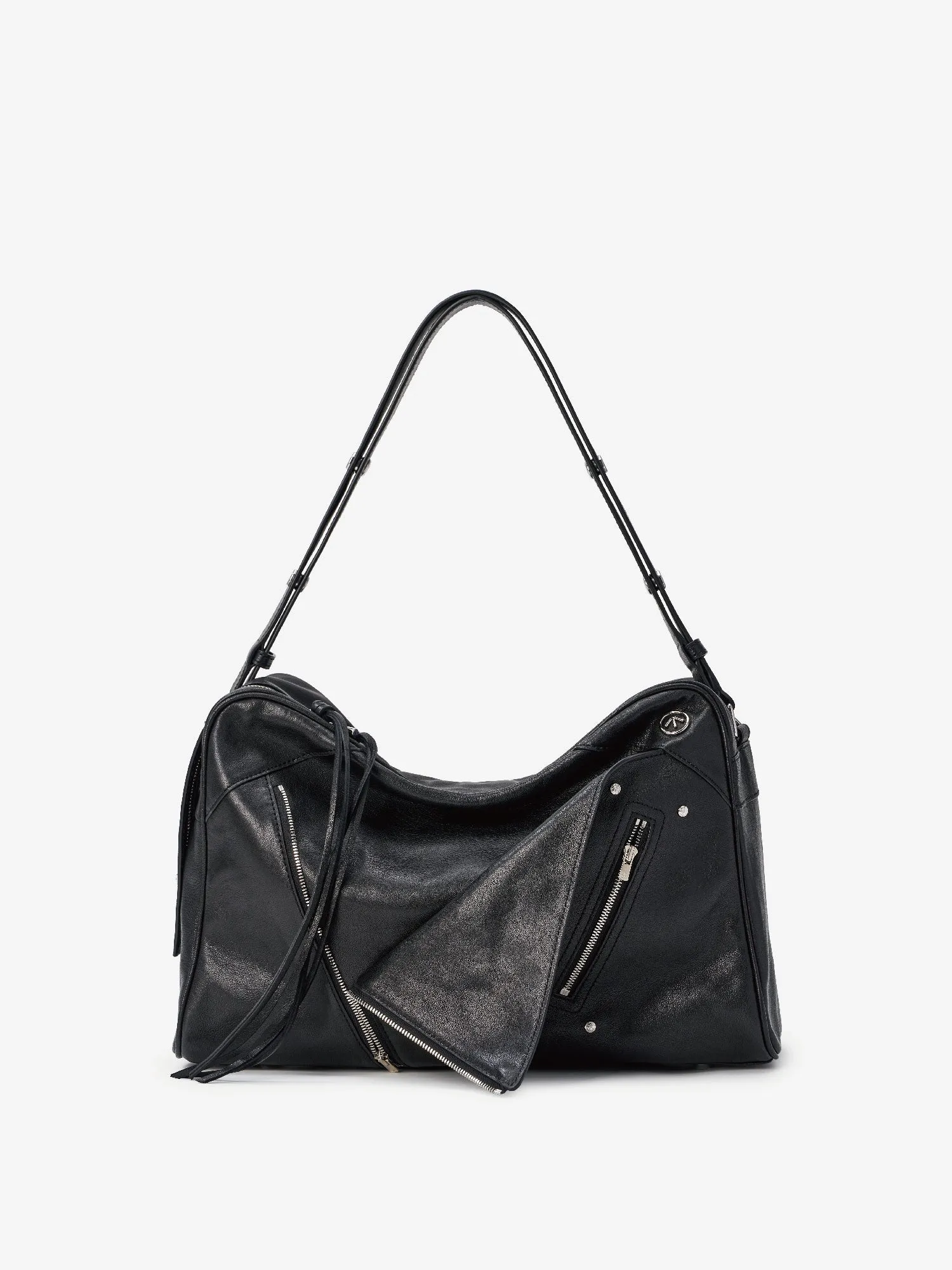
The bag that expects to change
GROTTO’s most revealing origin statement is also an instruction for how to look at its bags. Founder Huang Boqing, 黄柏青, says he designs only the first half of an object. Time and its user are expected to complete the rest.
He is drawn to “evolving leather,” he writes on the brand’s official site — material with a vitality that “intertwines with the wearer’s presence.” The second half of the story, he says, he leaves to time. The desired result is a bag that records handling, movement and age rather than resisting them.
The official history dates GROTTO, 个乐, to 2001. Its mark places an upward arrow inside the Chinese character 个, a device the brand connects to an “upward consciousness of freedom.” Huang is presented as a traveller who gathers cultural impressions across places and translates them into design.
This leaves GROTTO with an origin that is philosophical rather than biographical. The accessible official history tells us when the brand began, who founded it and what Huang wanted leather to do. It does not explain where the first shop or workshop opened, what Huang had been doing beforehand, how the business was financed, or which object came first.
What is clear is the material premise. GROTTO values leather precisely because it is unstable. A surface that deepens, marks and softens can become a record of possession. In Huang’s formulation the designer gives up complete authorship: the buyer does not receive a frozen final object, and use becomes part of the design process.
The brand says its principal leather comes from Tuscany and that bags are made through traditional stages including pattern making, hide selection, cutting, sewing and finishing. It also says it develops leather and special processes with leading tanneries and produces through its own workshop. These are meaningful claims for a label selling material character, though they remain first-party statements. MEI has not obtained tannery names, production addresses, certification or independent factory reporting.
GROTTO matters in the current soft-bag moment because its softness has an argument behind it. The bag is allowed to sag, crease and acquire a life. The apparent imperfection is presented as the continuation of the work.
This is also why its story requires restraint. The brand’s own English history now states that GROTTO was founded in Hong Kong in 2001, which is enough to publish the founding city as something the brand asserts. It is not enough to establish Huang’s education, his route into leather or how the business was financed — the polished summaries of those circulating online still trace to no accessible primary source, and remain excluded here.
Record
- 个乐
- Not verified
- Hong Kong
- Not verified
- Not verified
- 2001
- Huang Boqing 黄柏青
- Not verified
- handbags, leather goods
- Not verified
On the date: ELLE China's twentieth-anniversary piece dates the founding to 12 October 2001 in Hong Kong, by a designer newly returned from study in the UK. That is a dated republication rather than a registry record, and it reads as brand-supplied — but it is the first account of the founding published anywhere other than GROTTO's own property.
Read from the brand's own shop
2026-09-15 · market en-US
- Half the shop is above
- US$559
- US$399 to US$819 across everything listed
- Objects listed
- 46
- 39 available, 7 sold out
- On sale today
- 12
- Median cut 5% against the shop's own reference price
- Newest arrival
- 2026-09-11
- By the brand's own publication date
- Sizes offered
- S · L
- Letter sizing only; numbered runs are not comparable between shops
Read from GROTTO's public catalogue on 15 September 2026 and refreshed every day. The figures cover every object the shop lists, accessories and charms included, so the median is not a handbag price.
MEI sells none of this and earns nothing from it. It is listed at the brand's own shop ↗. See which Chinese fashion is selling out fastest.
What remains unverified
Reported — awaiting brand fact-check- What the 2001 date marks — registration, first workshop, first collection or first store — is still unstated. ELLE China gives a precise day, 12 October 2001, without saying what happened on it.
- Huang Boqing's education, previous work and route into leather design are unverified.
- The first product and first retail location are unverified. Hong Kong as the founding city rests on the brand's own English history page, not on an independent record.
- MEI renders the founder as Huang Boqing, the romanisation the brand itself uses in English, and ELLE China gives 黄柏青 with the creative persona 黄糊糊. Pinyin for 柏 also gives Baiqing, and other English coverage uses that form.
- Claims about Tuscan leather, partner tanneries and the founder's own workshop are first-party statements awaiting documentary or independent confirmation.
- MEI found no sufficiently detailed Chinese founder interview outside the brand's own website during this research pass.
Sources
- Independent reportingELLE China — 设计师品牌GROTTO个乐迎来20周年. Dates the founding to 12 October 2001 in Hong Kong and gives the founder as 黄柏青, creative persona 黄糊糊, returned from study in the United Kingdom ↗14 October 2021
- Primary · officialGROTTO official brand story ↗
A source being official establishes what the brand says. It does not independently establish sales, sourcing, manufacturing quality, awards or social impact — those remain attributed until MEI obtains records, institutional confirmation or firsthand product testing.